Key Takeaways
- The "Tepid Water" Climate Challenge: ANSI Z358.1 mandates flushing chemical burns with tepid water (16°C to 38°C) for at least 15 minutes. In the GCC, summer ambient water temperatures easily exceed this, making integrated industrial chillers for emergency showers a critical compliance requirement.
- Liquefaction vs. Coagulation Necrosis: Understanding the chemical agent is vital. Alkalis (bases) cause liquefaction necrosis, penetrating tissue deeper and faster than acids (which cause coagulation necrosis), often requiring prolonged flushing times of up to 60 minutes.
- The Neutralization Myth: Never attempt to neutralize a chemical burn on the skin (e.g., applying an acid to a base). This triggers an exothermic chemical reaction, generating extreme thermal heat that will severely worsen the tissue damage.
- Hydrogel Intervention: Following rigorous flushing, the immediate application of specialized hydrogel trauma dressings, such as Burnshield, is mandatory to halt burn progression, dissipate residual heat, and protect the compromised dermal layer from airborne industrial contaminants.
Introduction: The High-Stakes Petrochemical Landscape
The industrial backbone of Saudi Arabia and the broader Gulf Cooperation Council (GCC) is built upon the extraction, refinement, and processing of complex hydrocarbons and petrochemicals. Facilities ranging from massive Jubail refineries to regional desalination plants and localized manufacturing hubs handle millions of gallons of highly reactive, corrosive substances daily. In these high-stakes environments, exposure to caustic soda, sulfuric acid, hydrofluoric acid, and industrial solvents is an omnipresent threat.
Unlike thermal burns, which are caused by a brief transfer of intense heat, chemical burns are insidious. The chemical agent continues to destroy tissue, fat, and bone until it is mechanically removed or chemically inactivated. In the extreme climate of the Middle East, where workers already face severe heat stress and fatigue, a chemical splash incident can rapidly escalate into a fatal emergency if site protocols and Personal Protective Equipment (PPE) are not perfectly aligned.
For Health, Safety, and Environment (HSE) officers and procurement managers, mitigating chemical burn risks requires a two-pronged strategy: aggressive preventative PPE measures to stop the splash, and a meticulously engineered first aid response architecture to handle the aftermath. This comprehensive technical guide breaks down the physiology of chemical burns, the absolute mandates for emergency decontamination in the GCC, and the specific trauma supplies required to save tissue and lives.
The Physiology of Chemical Tissue Damage
To build an effective emergency response protocol, HSE professionals must first understand the biomechanics of how different industrial chemicals destroy human tissue. Chemical burns do not behave uniformly; their destruction is dictated by their pH level, concentration, and the duration of contact.
Acidic Burns and Coagulation Necrosis
Acids, such as sulfuric acid (battery acid), hydrochloric acid, and nitric acid, have a pH lower than 7. When strong acids contact the skin, they draw out water and denature the proteins in the tissue. This process, known as coagulation necrosis, rapidly kills the surface cells, forming a tough, leathery eschar (scab). While highly painful and destructive, this eschar actually acts as a temporary barrier, slowing the acid from penetrating deeper into the subcutaneous tissues and bloodstream.
Alkali Burns and Liquefaction Necrosis
Alkalis, also known as bases (e.g., sodium hydroxide/caustic soda, potassium hydroxide, wet cement, and ammonia), have a pH greater than 7. Alkali burns are universally considered more dangerous than acid burns. Alkalis interact with the fats and lipids in human tissue, causing saponification—essentially turning the tissue into soap. This process is known as liquefaction necrosis. Unlike acids, alkalis do not form a protective eschar. Instead, the liquefied tissue allows the chemical to penetrate continuously deeper, devastating muscles, nerves, and vascular systems until it is aggressively flushed out.
The Hydrofluoric Acid (HF) Anomaly
Hydrofluoric acid (HF), heavily utilized in oil refining (alkylation units) and metal cleaning, defies standard acid behavior. While it causes coagulation necrosis on the surface, the fluoride ions quickly penetrate deep into the body, binding to the calcium and magnesium in the bones and bloodstream. This systemic fluoride toxicity can trigger sudden, fatal cardiac arrest even from a relatively small skin exposure. HF requires an entirely separate, specialized emergency protocol.
The 15-Minute Rule: Immediate Emergency Response Protocols
In the event of a chemical splash, the first 10 to 15 seconds are critical. The speed at which the victim reaches a decontamination station directly dictates the severity of the permanent disfigurement or disability.
Step 1: Rescuer Protection
The most common secondary industrial accidents occur when untrained coworkers rush to assist a chemical burn victim without donning appropriate chemical protective clothing. Rescuers must immediately don heavy-duty chemical-resistant gloves (such as nitrile or neoprene blends from Ansell), splash goggles, and, if necessary, respiratory protection before touching the victim or their contaminated clothing.
Step 2: The Dry vs. Wet Protocol
- Dry Chemicals: If the exposure involves a dry powder (e.g., dry lime or agricultural fertilizers), do not apply water immediately. Adding water to dry reactive chemicals can trigger a violent exothermic reaction. The powder must be aggressively brushed off the skin and clothing using a dry cloth or soft brush before any flushing begins.
- Wet Chemicals: For liquid chemical splashes, proceed immediately to high-volume fluid flushing.
Step 3: Decontamination and Rapid Doffing
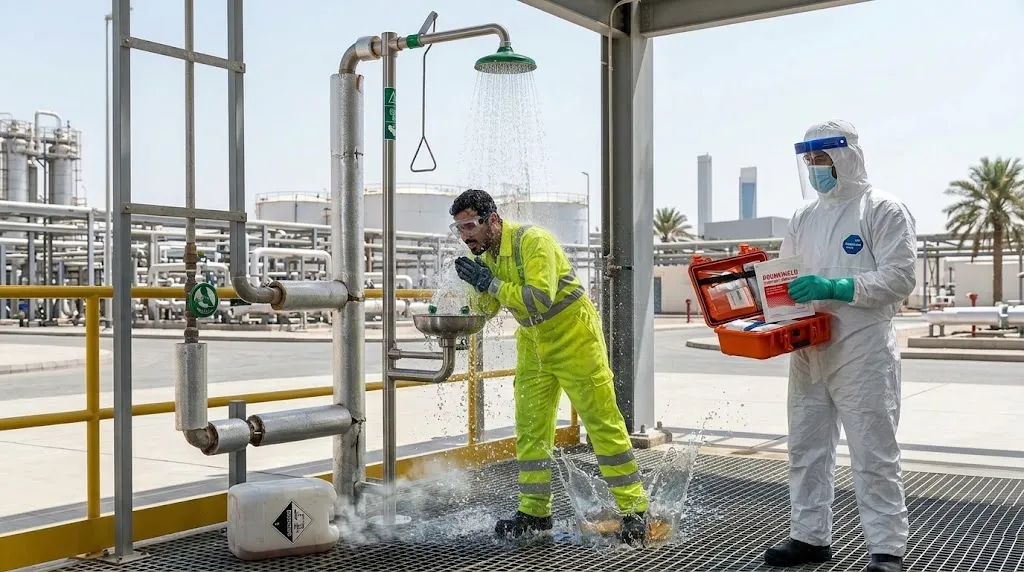
The victim must be moved to the nearest emergency shower. Flushing must begin instantly, and it must continue for a minimum of 15 to 20 minutes for standard acids, and up to 60 minutes for severe alkalis. Crucially, all contaminated clothing, footwear, and jewelry must be rapidly cut away or removed while the victim is under the shower. Saturated clothing acts as a chemical compress, forcing the corrosive agent deeper into the skin.
Essential First Aid PPE and Decontamination Infrastructure
Procurement managers must ensure that the site's physical infrastructure and trauma kits are strictly compliant with international standards, specifically adapted for the harsh realities of the Saudi Arabian climate.
ANSI Z358.1 Compliant Emergency Showers and Eyewash Stations
The American National Standards Institute (ANSI) Z358.1 standard outlines the strict requirements for emergency flushing equipment.
- Accessibility: Showers and eyewashes must be located within a 10-second unobstructed walk from the chemical hazard zone.
- Flow Rates: Plumbed showers must deliver a minimum of 20 gallons (75.7 liters) per minute. Eyewash stations must deliver 0.4 gallons (1.5 liters) per minute to both eyes simultaneously.
- The Tepid Water Mandate (The GCC Challenge): ANSI requires the flushing fluid to be "tepid"—defined as between 16°C and 38°C (60°F - 100°F). In the Middle East, overhead water tanks exposed to the summer sun can easily reach 50°C (122°F). Spraying a chemical burn victim with scalding water will massively accelerate the chemical reaction and induce severe thermal burns, sending the patient into deep shock. Industrial facilities in the GCC must invest in robust, ATEX-certified chiller systems and insulated piping to guarantee tepid water delivery year-round.
Advanced Burn Management: Burnshield Hydrogel Dressings
Once the chemical has been entirely flushed from the tissue (verified by testing the runoff water with pH strips), the wound must be dressed to prevent infection and manage residual tissue heat. Traditional dry gauze can stick to the compromised dermis, causing excruciating pain upon removal.
This is where Burnshield trauma dressings become an indispensable component of any industrial first aid kit. Burnshield dressings are saturated with a proprietary, sterile, water-based hydrogel matrix containing Melaleuca alternifolia (Tea Tree Oil).
- Heat Dissipation: The high water content of the hydrogel rapidly absorbs and dissipates residual heat from the tissues without causing systemic hypothermia.
- Barrier Protection: The gel forms an immediate physical barrier over the exposed nerve endings, significantly reducing pain, while shielding the raw tissue from airborne industrial dust and secondary infection.
- Non-Adherent: Unlike dry bandages, the hydrogel ensures the dressing will not adhere to the necrotic tissue, allowing hospital staff to easily remove it upon the patient's arrival at the burn unit.
Specific High-Risk Chemicals and Specialized Interventions
Standard water flushing is the universal first step, but certain chemicals require highly specific medical interventions immediately following the shower.
| Chemical Agent | Primary Hazard Type | Immediate First Aid Action | Required Specialized Medical PPE/Antidote |
|---|---|---|---|
| Hydrofluoric Acid (HF) | Systemic Toxicity / Cardiac Arrest | Flush with water for 5 minutes only. | Immediate, continuous massaging of Calcium Gluconate Gel (2.5%) into the burn site to bind fluoride ions. |
| Sodium Hydroxide (Caustic Soda) | Severe Liquefaction Necrosis | Flush continuously for a minimum of 45-60 minutes. | Sterile, pH-neutralizing eye wash solutions (e.g., Diphoterine) if available; heavy hydrogel dressings post-flush. |
| Sulfuric Acid | Coagulation Necrosis / Thermal Heat | Flush with massive volumes of water. | Standard Burnshield dressings post-flush; monitor for shock due to extreme pain. |
| White Phosphorus | Spontaneous Ignition in Air | Flush with water; keep the area completely submerged. | Keep the wound covered with wet, saline-soaked dressings to prevent oxygen contact until surgical debridement. |
Preventative PPE: Stopping the Splash at the Source
The most effective first aid is prevention. Saudi Labor Law (MHRSD regulations) dictates that employers must provide adequate protective gear tailored precisely to the Safety Data Sheet (SDS) of the chemicals handled on-site.
- Chemical Suits: For high-volume transfer operations, workers must be equipped with liquid-tight splash suits (Type 3 or Type 4 CE certified) that repel caustic fluids without trapping excessive metabolic heat.
- Hand Protection: Standard leather or cotton gloves absorb chemicals instantly. Operators require heavy-duty, extended-cuff chemical-resistant gloves crafted from nitrile, neoprene, or butyl rubber, depending on the chemical's permeation rate.
- Facial Defense: Safety glasses are insufficient for chemical hazards. Indirect-vented splash goggles paired with a full polycarbonate face shield are mandatory to protect the eyes and respiratory pathways from high-pressure blowouts.
Conclusion
Managing chemical burns in the heavy industries of the GCC is a race against time, thermodynamics, and cellular destruction. A localized chemical splash can transition into a life-threatening systemic crisis in a matter of minutes if the response is disorganized or ill-equipped. By strictly adhering to ANSI Z358.1 mandates for tepid water infrastructure, investing in specialized chemical-resistant PPE to prevent exposure, and stocking accessible trauma stations with advanced hydrogel solutions like Burnshield, HSE teams can effectively halt burn progression. True compliance goes beyond ticking regulatory boxes; it requires building a resilient, educated workforce armed with the exact technical tools necessary to mitigate catastrophic industrial trauma before the ambulance even arrives.
FAQs
-
No. Absolutely never use ice. Applying ice to a chemical burn causes severe vasoconstriction (narrowing of the blood vessels). This reduces blood flow to the already dying tissue, accelerating necrosis and causing frostbite on top of the chemical injury. Always rely on tepid water flushing followed by ambient-temperature hydrogel dressings.
-
Never attempt chemical neutralization on human tissue. While it seems logical to neutralize an acid with a base (or vice versa), this creates a violent exothermic reaction. The chemical reaction generates massive amounts of thermal heat, meaning the victim will suffer a severe thermal burn precisely where the chemical burn is located, drastically worsening the trauma. Water is the only universal diluent.
-
Visually, it is impossible to tell if a chemical has been completely removed. In a highly equipped industrial setting, responders use pH indicator strips touched to the runoff water (not directly to the wound). Flushing should continue until the runoff water registers a neutral pH of 7.0. If pH strips are unavailable, the rule of thumb is 20 minutes for acids and up to 60 minutes for alkalis, halting only for immediate medical evacuation.