
Key Takeaways
- Hazard Isolation is Critical: Standard nitrile gloves offer unparalleled chemical resistance against aliphatic hydrocarbons but provide absolute zero defense against the heavy mechanical crush hazards omnipresent in upstream oil and gas operations.
- The ANSI/ISEA 138 Mandate: For genuine impact protection on Saudi Arabian drilling rigs, hand protection must feature engineered Thermoplastic Rubber (TPR) exoskeletons certified under ANSI/ISEA 138 standards to physically dissipate kinetic energy.
- The Hybrid Imperative: The definitive standard for heavy oil handling in the GCC is a hybrid solution: a Cut Level 5 (or ANSI A5+) base liner, a double-dipped nitrile fluid barrier with a micro-foam palm, and a TPR dorsal exoskeleton.
- Total Cost of Ownership (TCO): Procuring specialized, dual-threat hand protection from elite manufacturers like Ansell and Ringers Safety Gloves dramatically lowers the Total Cost of Ownership by reducing recordable hand injuries, medical evacuations, and daily PPE replacement rates in harsh climates.
Introduction: The High Stakes of Hand Protection in the GCC
Operating within the upstream drilling, midstream transport, and downstream refining sectors of Saudi Arabia and the broader Gulf Cooperation Council (GCC) presents a uniquely hostile environment for the human hand. Workers in this region are subjected to a brutal combination of extreme ambient temperatures frequently exceeding 50°C, highly abrasive surfaces, and constant exposure to crude oil, synthetic drilling muds, and caustic lubricants. In this high-stakes industrial arena, hand and finger injuries remain among the most frequently recorded occupational incidents.
A significant percentage of these injuries result from a fundamental mismatch between the assigned Personal Protective Equipment (PPE) and the actual on-site hazard profile. For Health, Safety, and Environment (HSE) managers and procurement specialists, the PPE debate frequently centers around two primary categories: nitrile-coated gloves and heavy-duty impact-resistant gloves. While both serve critical functions, confusing their applications can lead to catastrophic injuries, ranging from severe chemical contact dermatitis to permanent bone fractures resulting from heavy iron pinch-point accidents.
This comprehensive technical guide dissects the specific polymer engineering behind nitrile and impact-resistant gloves, compares their performance metrics against international safety standards (EN 388:2016 and ANSI/ISEA 138-2019), and outlines exactly what type of hand protection is mandated for various stages of oil handling in the Middle East.
The Biomechanics of Hand Injuries in Petrochemical Operations
To understand the necessity of highly specialized glove technologies, one must first categorize the hazards present on a typical GCC oil rig or petrochemical facility, and how they interact with the biomechanics of the hand. The human hand consists of 27 bones, intricately connected by a complex network of tendons, ligaments, and nerves with very little protective adipose tissue (fat).
Chemical, Thermal, and Fluid Hazards
Hydrocarbons, whether in the form of raw crude oil, refined diesel, or Oil-Based Muds (OBM), act as aggressive chemical solvents. Prolonged skin contact with these substances strips the epidermis of its natural protective oils, leading to severe contact dermatitis, chemical burns, and the systemic transdermal absorption of toxic compounds.
Furthermore, tools, valves, and drill pipes coated in these fluids become highly lubricated. This exponentially increases the risk of dropped objects and loss of mechanical control if the worker's glove lacks a specialized, fluid-displacing grip matrix. In the extreme heat of the Saudi summer, sweat accumulation inside a non-breathable glove also introduces the risk of severe maceration and fungal infections.
Mechanical and Kinetic Hazards
The upstream oil and gas environment is characterized by the movement of "heavy iron." Roughnecks, derrickmen, and maintenance crews constantly maneuver massive steel pipes, operate heavy high-torque valves, and work in close proximity to automated machinery like iron roughnecks and top drives. The primary kinetic hazards include:
- Pinch Points and Crush Zones: Areas where two heavy objects come together (e.g., pipe joints, tongs), capable of crushing metacarpals and phalanges instantly.
- Blunt Force Impact Trauma: Dropped tools, swinging chains, or blunt force strikes from shifting machinery.
- Lacerations and Severe Abrasions: Handling frayed wire ropes, sharp metal shavings (swarf), and abrasive drill casings.
Standard cut-and-sewn cotton or basic leather PPE cannot address both fluid and kinetic hazards simultaneously without utilizing specialized multi-layer polymer construction.
Deep Dive: Nitrile Gloves in Oil Handling
Nitrile Butadiene Rubber (NBR), commonly referred to simply as nitrile, is a synthetic copolymer of acrylonitrile and butadiene that has revolutionized industrial hand protection. Unlike natural rubber latex, which degrades and swells rapidly when exposed to oils and fuels, nitrile offers exceptional chemical resistance to aliphatic hydrocarbons, oils, and greases.
The Polymer Engineering of Nitrile Coatings
In the context of industrial oil handling, we are not discussing thin, disposable nitrile exam gloves. Instead, we refer to seamless knit industrial gloves (often constructed from nylon, High-Performance Polyethylene [HPPE], or Kevlar) that are dipped in liquid nitrile polymer.
Manufacturers utilize sophisticated dipping techniques to alter the surface physics and grip profile of the glove:
- Smooth/Flat Nitrile: Provides an excellent, highly impermeable liquid barrier. This is often used as a base dip to ensure oil does not reach the skin. However, in heavily oiled conditions, a smooth nitrile surface can become dangerously slick, reducing grip strength.
- Micro-Foam Nitrile: The liquid nitrile is infused with microscopic air bubbles during the curing process. When the worker grips an oily steel pipe, these microscopic bubbles act like thousands of tiny suction cups, channeling and displacing the surface oil, allowing the rubber to make direct friction contact with the object.
- Sandy Nitrile: Features a heavily textured, abrasive finish applied during the final curing stage. This provides maximum friction against heavy industrial grease and highly viscous drilling muds.
Advantages and Operational Limitations
Nitrile-coated gloves excel in downstream operations, petrochemical laboratory environments, and light maintenance tasks. They offer high tactile sensitivity, allowing workers to confidently thread small nuts and bolts, operate delicate instrumentation, or handle communication devices. They also provide excellent abrasion resistance and completely prevent oil from saturating the fabric.
However, standard nitrile-dipped gloves possess a critical, potentially fatal vulnerability: they offer absolute zero protection against blunt force trauma. If a 50-kilogram pipe shifts and pins a worker's hand against a steel rack, a standard nitrile glove will do nothing to prevent crushed bones.
Deep Dive: Impact-Resistant Gloves and Kinetic Defense
Impact-resistant gloves were born out of absolute necessity to protect workers on drilling floors where heavy equipment routinely causes catastrophic crushing injuries. These gloves are engineered with a specific architectural focus on the dorsal (back) side of the hand.
The Science of Thermoplastic Rubber (TPR)
The defining feature of a true impact glove is its exoskeleton, typically constructed from Thermoplastic Rubber (TPR) or Thermoplastic Elastomer (TPE). These engineered polymer materials are ultrasonically welded or heavily stitched onto the back of the glove, covering the knuckles, metacarpal bones, and the full articulated length of the fingers.
When a blunt force strikes the back of the hand, the TPR acts as an energy-absorbing crumple zone. Instead of the kinetic energy transferring directly into the fragile bones, the TPR compresses and disperses the energy outward across a much wider surface area. This significantly reduces the localized peak force, often meaning the difference between a minor bruise and a multi-fragmentary bone fracture requiring surgical intervention.
Understanding ANSI/ISEA 138 Impact Standards
For procurement managers ensuring strict compliance with safety mandates (such as those enforced by Saudi Aramco or SABIC), it is not enough for a glove to simply have rubber bumpers glued to it. It must be rigorously certified. The ANSI/ISEA 138-2019 standard established a uniform, scientific testing methodology for impact resistance.
The test involves dropping a flat 2.5-kilogram mass with an impact energy of 5 Joules directly onto the glove's knuckles and fingers. Highly sensitive force load cells measure the peak force transmitted through the glove in Kilonewtons (kN). The lower the transmitted force, the higher the protection level.
- ANSI/ISEA 138 Level 1: Transmitted force ≤ 9.0 kN. Ideal for light maintenance, scaffolding, and general logistics duties where minor bumps are expected.
- ANSI/ISEA 138 Level 2: Transmitted force ≤ 6.5 kN. The required standard for general oil and gas extraction, rigging, heavy construction, and valve operation.
- ANSI/ISEA 138 Level 3: Transmitted force ≤ 4.0 kN. Reserved for the most extreme kinetic hazards, such as direct heavy iron handling on the drill floor and wireline operations.
The Failure Point of Standard Impact Gloves
While traditional cut-and-sewn impact gloves (often made of synthetic leather and spandex) provide excellent dorsal protection, they frequently fail completely in fluid resistance. Synthetic leather acts like a sponge, absorbing crude oil and toxic drilling mud. Once saturated, the glove becomes incredibly heavy, dangerously slick, and exposes the worker's skin to chemical dermatitis. In the intense heat of the Saudi summer, a saturated, heavy glove also exponentially increases heat stress and severe hand fatigue.
The Definitive Hybrid Solution: Nitrile-Dipped Impact Gloves
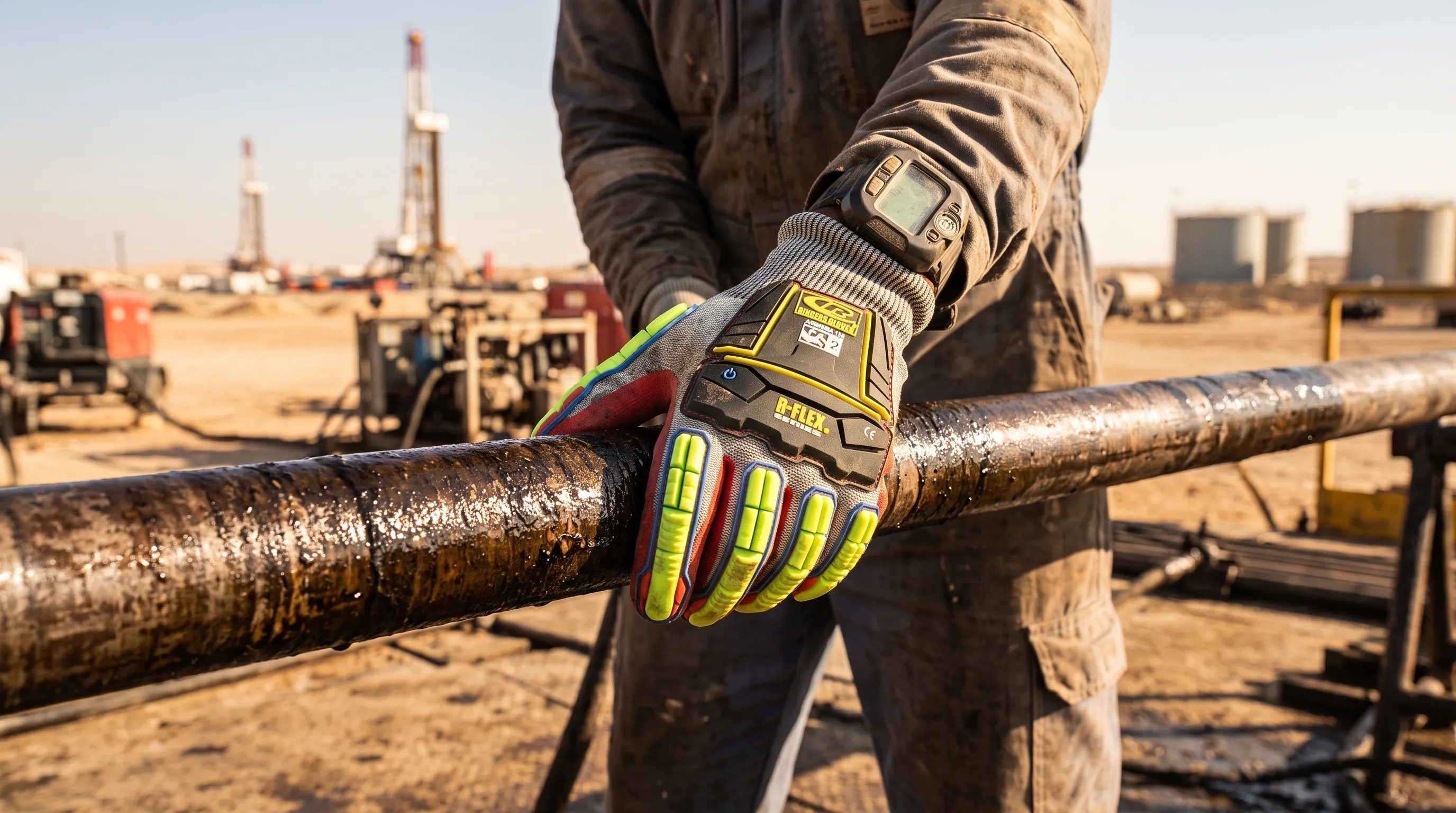
The ultimate answer for heavy oil handling in the GCC is the convergence of both polymer technologies: the Nitrile-Dipped Impact Glove. This hybrid engineering approach, championed by industry-leading innovators such as Ringers Safety Gloves and Ansell, offers a complete 360-degree defense mechanism.
These advanced hybrid gloves begin with a high-performance shell (HPPE, fiberglass, or steel-core yarn) that provides maximum cut resistance—often achieving EN 388 Cut Level F or ANSI A5+ ratings. This seamless shell is then double-dipped.
The first dip is a flat, smooth nitrile coating covering the entire hand to create a 100% liquid-proof, chemical-resistant barrier. The second dip, applied only to the palm and fingertips, utilizes a micro-foam or sandy nitrile texture to ensure an unbreakable grip on heavily oiled pipes. Finally, a highly articulated, ANSI-rated TPR exoskeleton is thermally bonded to the back of the hand to achieve Level 2 or Level 3 impact protection.
Comprehensive Comparative Analysis Matrix
| Feature / Capability | Standard Nitrile Dipped | Traditional Synthetic Leather Impact | Hybrid Nitrile-Dipped Impact |
|---|---|---|---|
| Primary Defense Mechanism | Chemical / Liquids / Fine Grip | Blunt Force / Pinch Points | Comprehensive (Chemical + Mechanical) |
| Liquid Repellency | Excellent (Impermeable barrier) | Poor (Absorbs fluids rapidly) | Excellent (Double-dipped nitrile barrier) |
| Oily Grip Performance | High (with Sandy/Foam finish) | Low (Becomes dangerously slick) | High (Textured nitrile palm) |
| Impact Protection | None (0 kN energy dissipation) | High (ANSI/ISEA 138 compliant) | High (ANSI/ISEA 138 compliant TPR) |
| Cut Resistance (EN 388) | Varies (Depends on base liner) | Moderate (Usually standard synthetics) | Extreme (Engineered to Cut Level E/F) |
| Ideal GCC Application | Downstream processing, laboratories | Dry construction, heavy logistics | Upstream drilling, roughnecks, rigging |
Procurement Strategy for KSA and GCC Operations
When purchasing PPE for large-scale operations across Saudi Arabia, the UAE, and the wider Gulf, procurement managers must shift their focus away from the initial unit price and analyze the Total Cost of Ownership (TCO).
Purchasing cheap, uncertified cotton or basic synthetic leather gloves for a roughneck crew will result in an astronomical turnover rate. Workers will discard saturated, heavy, or torn gloves daily, skyrocketing the long-term consumable expenditure. More importantly, inadequate impact and chemical protection directly correlates to a higher frequency of recordable incidents, expensive medical evacuations, and highly costly operational downtime.
By investing in specialized, ANSI-rated hybrid impact gloves from trusted, authorized distributors, facilities ensure absolute compliance with stringent local labor laws, Ministry of Human Resources and Social Development (MHRSD) mandates, and internal corporate HSE policies. These advanced gloves offer significantly higher durability, maintaining their protective qualities and structural integrity for weeks rather than days, ultimately delivering a superior return on investment.
Conclusion
The debate between nitrile and impact-resistant gloves is no longer a matter of choosing one over the other; it is about accurately matching advanced polymer engineering to the specific, multi-faceted hazard profile of the task. For light chemical handling and downstream maintenance, high-dexterity nitrile coatings remain unparalleled. However, on the drill floor, where crushing hazards and heavy iron dictate the working environment, ANSI-rated kinetic impact protection is a non-negotiable necessity.
For the ultimate defense in the demanding, high-heat conditions of the GCC oil and gas sector, modern hybrid nitrile-coated impact gloves provide the comprehensive liquid barrier, enhanced oily grip, and severe blunt-force dissipation required to ensure every worker's hands remain fully protected, compliant, and operational. By integrating Reda Safe's advanced hand protection solutions into your procurement strategy, you bridge the gap between rigorous safety compliance and functional worker comfort.
FAQs
-
EN 388 is the European standard (widely adopted as the baseline in the GCC) that evaluates gloves for Abrasion, Circular Blade Cut, Tear, and Puncture (represented as a 4-digit code under a shield icon). The 2016 update added a letter for ISO straight-blade cut resistance (A-F) and a "P" if the glove passes a basic impact test. However, the EN 388 impact test is a simple Pass/Fail metric. ANSI/ISEA 138 is a strictly North American standard entirely dedicated to measuring and classifying impact resistance with far greater granularity and scientific rigor (Levels 1-3). High-quality PPE authorized for use in Saudi Aramco or SABIC facilities will generally carry dual certifications to satisfy both cut and impact metrics accurately.
-
High-quality Nitrile Butadiene Rubber (NBR) and engineered TPR are highly thermally stable and will not melt in standard ambient heat, even at the 55°C+ temperatures occasionally recorded on Middle Eastern drill floors. However, prolonged exposure to direct, intense UV light combined with extreme heat, ozone, and petrochemicals can cause the rubber polymers to oxidize, cross-link, and become brittle over time. Proper storage in cool, shaded, and dry environments when off-shift is absolutely critical to extending the PPE's operational lifespan and maintaining compliance.
-
Yes, but strict laundering protocols must be followed to avoid degrading the TPR thermal adhesives or fracturing the internal cut-resistant glass/steel fibers. Most hybrid nitrile impact gloves can be machine washed at temperatures not exceeding 40°C (104°F) using mild, non-ionic commercial detergents. Bleach, strong solvents, and dry cleaning chemicals are strictly prohibited as they break down the nitrile barrier. Crucially, the gloves must be air-dried; using commercial heated tumble dryers will warp the TPR exoskeletons, destroy the adhesives, and completely compromise the glove's structural integrity.
-
Double-gloving is a common but dangerous workaround on rigs. Wearing a disposable nitrile exam glove under a synthetic leather impact glove traps sweat against the skin, radically increasing the risk of heat rash and maceration in the GCC climate. Furthermore, the layers slide against each other, drastically reducing tactile sensitivity and grip strength, which increases the likelihood of dropped objects. A unified, hybrid nitrile-dipped impact glove eliminates these risks entirely.