Key Takeaways
- Zero Tolerance for Cartridges: Air-purifying respirators and dust masks offer zero protection against Hydrogen Sulfide (H2S); Saudi Aramco strictly mandates atmosphere-supplying equipment like positive-pressure SCBAs for planned work in sour gas environments.
- IDLH at 100 ppm: NIOSH classifies H2S concentrations of 100 parts per million (ppm) as Immediately Dangerous to Life or Health (IDLH). Furthermore, olfactory fatigue occurs rapidly, meaning workers cannot rely on their sense of smell to detect leaks.
- Positive-Pressure Mandate: All Self-Contained Breathing Apparatus (SCBA) and airline respirators used on Saudi Aramco sites must be full-face and operate in a positive-pressure (pressure-demand) mode. Negative-pressure or half-face respirators are strictly prohibited.
- Grade D Air Quality: Breathing air supplied to RPE must meet Compressed Gas Association (CGA) Grade 'D' requirements, supported by proper particulate filtration and temperature monitoring.
Introduction: The Reality of Sour Gas in the GCC
Operating within the petrochemical and oil and gas sectors of Saudi Arabia and the broader Gulf Cooperation Council (GCC) region presents a unique set of occupational hazards. Among the most lethal of these is Hydrogen Sulfide (H2S), commonly referred to in the industry as "sour gas." Present in drilling operations, refineries, and confined spaces like storage tanks and sewer systems, H2S is a highly toxic, colorless, and flammable gas. In extreme GCC climates—where temperatures regularly exceed 45°C—managing respiratory protection against this gas requires not only specialized equipment but also strict adherence to rigorous regulatory frameworks.
Saudi Aramco, one of the world's largest integrated energy and chemicals companies, enforces some of the most stringent occupational safety and health standards on the planet. For procurement managers, HSE officers, and site supervisors, ensuring compliance with the Saudi Aramco Contractor Safety Manual (CSM) is a non-negotiable prerequisite for obtaining work permits and maintaining site access. Failing to equip personnel with the correct Personal Protective Equipment (PPE) is not just a regulatory violation; in an H2S environment, it is a matter of life and death.
This comprehensive guide breaks down the exact respiratory protection equipment (RPE) required to comply with Saudi Aramco standards, the physiological dangers of H2S, and how to select the right positive-pressure systems and escape sets for your workforce.
The Invisible Threat: Understanding Hydrogen Sulfide (H2S)
Before selecting PPE, it is crucial to understand the behavior of Hydrogen Sulfide and why it dictates such rigid equipment mandates. H2S is a byproduct of the decomposition of organic matter and is naturally occurring in crude oil and natural gas.
Physical Properties and Accumulation
H2S is approximately 1.19 times heavier than air. This specific gravity means that the gas does not easily dissipate in still air. Instead, it sinks and settles in low-lying areas. In industrial plants and drilling rigs, this translates to dangerous accumulations in trenches, sumps, cellars, manifolds, and poorly ventilated confined spaces. Workers entering these lower elevations are at an immediate risk of encountering concentrated pockets of the gas.
The Phenomenon of Olfactory Fatigue
At very low concentrations (around 0.01 to 1.5 ppm), H2S emits a distinct "rotten egg" odor. However, relying on the human nose to detect this gas is a fatal error. As concentrations approach 100 ppm, the gas rapidly deadens the olfactory nerves—a physiological response known as olfactory fatigue. The worker loses the ability to smell the gas entirely, creating a false sense of security while they are actively being poisoned. At concentrations of 500 to 700 ppm, staggering and collapse can occur within minutes. Above 700 ppm, a single breath can induce instantaneous unconsciousness and respiratory paralysis.
Global Exposure Limits: OSHA vs. NIOSH
To understand the baseline for Aramco's alarm set points, HSE professionals must reference both the Occupational Safety and Health Administration (OSHA) and the National Institute for Occupational Safety and Health (NIOSH) exposure limits.
| Regulatory Body | Standard Type | Exposure Limit | Description |
|---|---|---|---|
| NIOSH | REL (Recommended Exposure Limit) | 10 ppm | 10-minute ceiling limit that should not be exceeded at any time. |
| OSHA | PEL (Permissible Exposure Limit) | 20 ppm | General industry ceiling limit. |
| OSHA | Peak Limit | 50 ppm | Maximum peak allowable for a single 10-minute period if no other exposure occurs. |
| NIOSH | IDLH | 100 ppm | Immediately Dangerous to Life or Health; requires specialized rescue RPE. |
Saudi operators typically set personal multi-gas detector alarms to align with or drop below the stricter NIOSH limits (often triggering a low alarm at 10 ppm and a high alarm at 15 ppm). In restricted areas, wearing a bump-tested, calibrated personal gas monitor in the breathing zone is a mandatory, stop-work compliance rule.
Saudi Aramco RPE Mandates for H2S Environments
When engineering and administrative controls cannot entirely eliminate the risk of H2S exposure, Saudi Aramco's PPE standards (outlined in frameworks like GI 1780.001 and the CSM) mandate the use of highly specific Respiratory Protective Equipment.
Why Cartridge Masks Are Prohibited
One of the most critical compliance points in the GCC petrochemical sector is the complete prohibition of air-purifying respirators (cartridge or filter-type dust masks) for H2S protection. H2S has poor warning properties due to olfactory fatigue. An air-purifying mask relies on a chemical cartridge to filter out toxins; if the cartridge becomes saturated and breakthrough occurs, the worker will not be able to smell the gas penetrating the mask.
Furthermore, these masks provide no oxygen. Because H2S incidents often displace ambient oxygen, leading to an oxygen-deficient atmosphere (less than 19.5% oxygen), only atmosphere-supplying respirators are permitted.
The Positive-Pressure Requirement
Saudi Aramco explicitly states that all Self-Contained Breathing Apparatus (SCBA) and airline systems used in toxic environments must be of the positive-pressure (also known as pressure-demand) type.
- Negative-Pressure Respirators: These draw air in when the user inhales, creating a negative pressure inside the facepiece. If the face seal is compromised (by sweat, facial hair, or movement), contaminated outside air will be drawn directly into the mask. These are strictly forbidden for H2S use.
- Positive-Pressure Respirators: These maintain a continuous, slight outward pressure of clean air inside the facepiece. If the seal is temporarily broken, the clean air pushes outward, preventing toxic H2S from leaking in.
Additionally, Aramco mandates that these systems must be full-face. Half-face positive-pressure systems are not allowed, as high concentrations of H2S (50-100 ppm) cause serious eye damage and severe respiratory tract irritation.
Selecting the Right Equipment: SCBAs vs. Airline Systems
Procurement managers must equip their teams based on the duration and nature of the work being performed in the sour gas zone. The choice generally falls between standalone SCBAs and Supplied-Air Respirators (SAR).
Self-Contained Breathing Apparatus (SCBA)
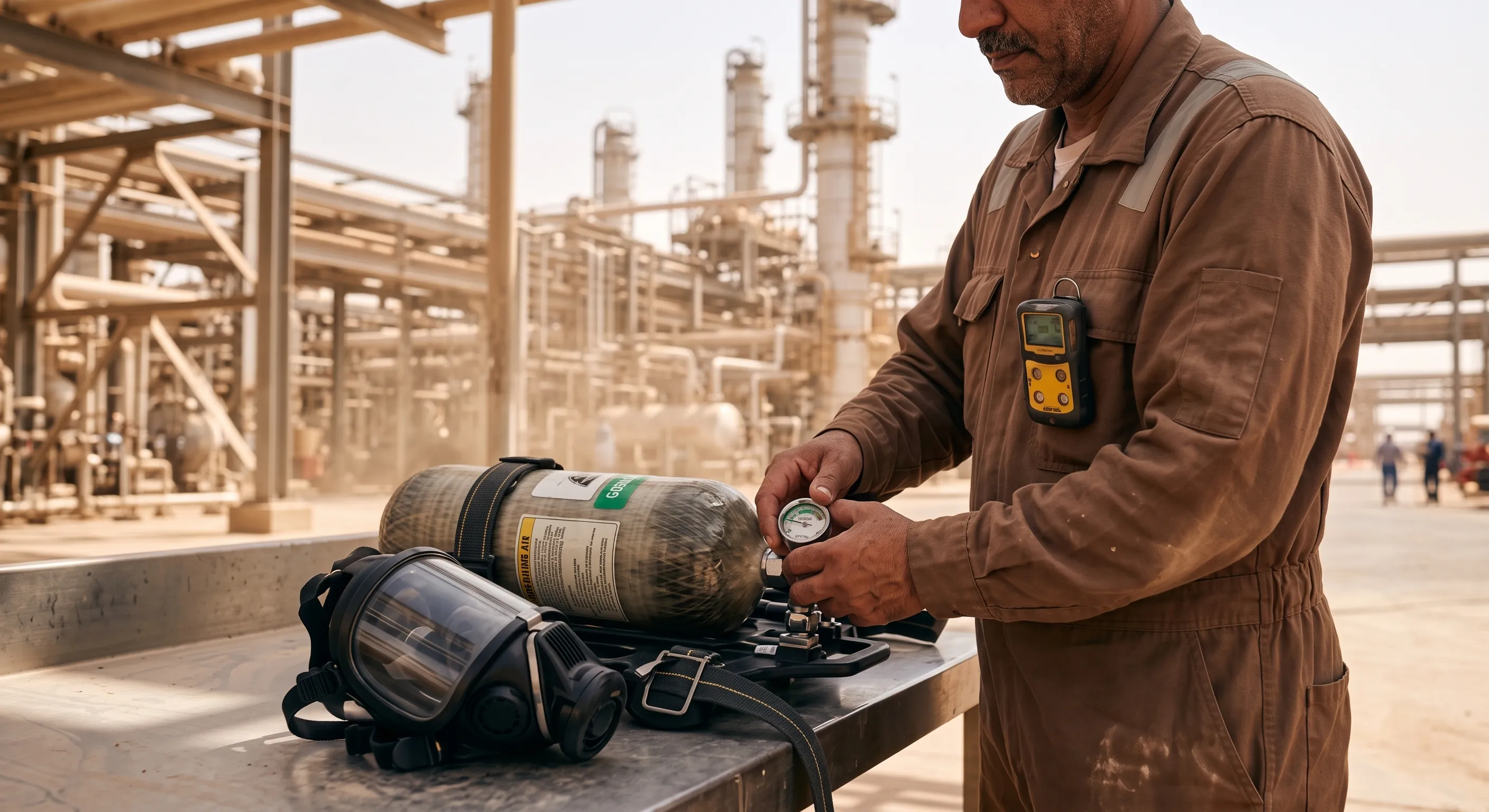
For emergency response, rescue operations, or short-duration maintenance inside IDLH environments, the SCBA is the industry standard. Workers carry their compressed air supply in a high-pressure composite cylinder on their back.
- Advantages: Unrestricted mobility. The worker is not tethered to an air hose, making it ideal for navigating complex scaffolding or pipe racks common in Saudi refineries.
- Limitations: The air supply is finite (typically 30, 45, or 60 minutes). Furthermore, carrying a heavy cylinder in 45°C heat significantly increases worker fatigue and the risk of heat stress.
Supplied-Air Respirators (Airline Systems)
For extended planned work in H2S atmospheres—such as prolonged welding, tank cleaning, or structural repairs—airline systems are required. The worker wears a full-face respirator connected via an air hose to a distant air cascade system or compressor located in a safe, upwind zone.
- Aramco Compliance for SAR: When using an airline system in an H2S zone, the worker must also wear a small, auxiliary escape cylinder (usually 5 to 10 minutes of air) mounted on their hip. If the main airline is severed or the compressor fails, this escape bottle provides enough clean air to evacuate the IDLH zone.
- Grade D Breathing Air: Saudi Aramco specifies that the breathing air supplied through these cascade systems must meet Compressed Gas Association (CGA) Grade 'D' requirements. This means the air must be strictly monitored for carbon monoxide levels, oil mist, particulate matter, and moisture. In the extreme heat of the GCC, air temperature monitoring and in-line cooling are also vital to prevent pumping scorching air directly into a worker's lungs.
Emergency Escape Sets (EEBDs)
For personnel working in designated H2S zones who are not performing tasks requiring an SCBA, the carriage of an Emergency Escape Breathing Device (EEBD), commonly known as an escape set, is mandatory.
These are lightweight, high-visibility hoods connected to a small compressed air cylinder slung over the shoulder or chest. They typically provide 5 to 15 minutes of constant-flow breathing air.
- Purpose: Escape sets are strictly for self-rescue. They must never be used to enter an H2S area or attempt a rescue.
- Donning Speed: The design of escape hoods allows them to be donned rapidly (often over glasses or facial hair) in the event of a sudden gas release. Workers must be heavily drilled on donning these sets in under 10 seconds without hesitation.
Confined Space Entry and Rescue Protocol
Entering a confined space in a petrochemical facility requires an intricate web of PPE and specialized hardware. When H2S is a potential hazard, the PPE needs multiply.
If a worker collapses inside a confined space due to H2S exposure, a non-entry rescue is always the primary objective. This requires the preemptive setup of rescue hardware. Workers must wear a full-body extraction harness connected to a mechanical winch and a rescue tripod positioned above the entry point.
Never attempt an unprotected rescue. A recurring tragedy in industrial safety is the "cascade effect," where a worker collapses from H2S, and a co-worker rushes in to save them without donning an SCBA, resulting in multiple fatalities. Saudi Aramco regulations are absolute on this: a person collapsed in an H2S atmosphere can only be reached by highly trained rescuers actively wearing positive-pressure SCBAs.
Inspection, Maintenance, and Fit Testing
Owning the correct respiratory equipment is only half of the compliance equation; maintaining it in the harsh GCC environment is the other.
Pre-Use Inspections and Face Seal Checks
Every worker is required by Aramco standards to visually inspect their RPE before and after every use. This includes checking cylinder pressure gauges, inspecting harnesses for chemical degradation, and ensuring all valves operate smoothly. Furthermore, personnel must perform a face seal check to ensure a proper vacuum and positive pressure seal prior to entering the work zone.
The Impact of Facial Hair
Safety managers must strictly enforce shaving policies. A proper seal on a full-face SCBA cannot be achieved if the user has a beard or significant facial hair. The interference prevents the silicone skirt of the mask from bonding with the skin, which in a positive-pressure system will cause the mask to rapidly vent its air supply, draining a 30-minute cylinder in a fraction of the time.
Maintenance Cycles
In Saudi Arabia, high ambient temperatures, abrasive sandstorms, and extreme humidity degrade rubber and silicone components faster than in temperate climates. Equipment must be stored in cool, dry environments, away from direct UV exposure. SCBA cylinders must undergo strict hydrostatic testing according to manufacturer specifications and regulatory mandates to ensure they can safely hold breathing air under extreme pressure.
Conclusion
Safeguarding personnel against Hydrogen Sulfide in the GCC’s harsh industrial landscape leaves zero room for error or equipment compromise. Complying with Saudi Aramco's rigorous PPE standards ensures that workers are shielded by technically sound, positive-pressure respiratory systems designed specifically for IDLH environments.
From selecting the appropriate full-face SCBAs for emergency response to ensuring all cascade systems provide verified Grade D breathing air, procurement and HSE teams must approach H2S hazards with a multi-layered defense strategy. By prioritizing rigorous face-fit testing, maintaining unyielding discipline regarding gas monitors, and equipping teams with compliant extraction harnesses and escape hoods, facilities can mitigate the invisible threat of sour gas and ensure every worker returns home safely.